American Basswood
From responsibly managed forests, and every wood component is color matched to the slat, including the wand and the valance.

Wood & Faux Blinds
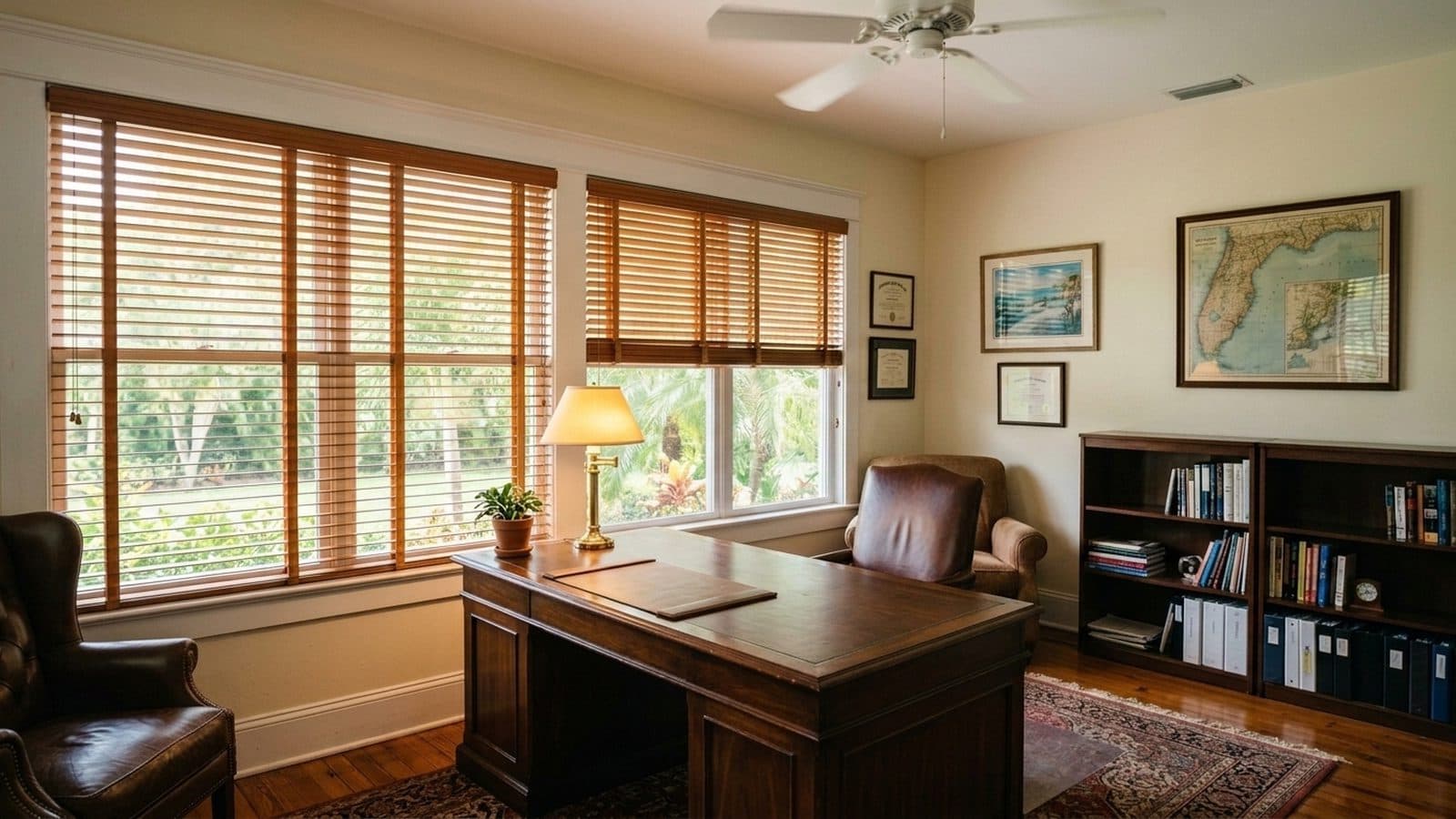
Custom wood blinds in American Basswood, cut and finished in three slat widths. Cordless as standard, and motorized with tilt and lift where a client wants it, which is rare on a wood blind.
How they are made
From responsibly managed forests, and every wood component is color matched to the slat, including the wand and the valance.
From lumber through to the finished custom blind under one roof, which is what makes a short lead time on a commercial job possible.
Because the program does not depend on imports from Asia. Commercial jobs of any size, in any color, in a short turnaround.
Slat widths
Every color and every option is available in all three, so the width is a design decision rather than a limit on what else you can specify.
The narrow slat, for small windows and French doors. Also the substitute for a 1 inch blind, and the only narrow slat cordless blind on the market.
Fits most windows, and opens to more view than the narrow slat. The default on a typical residential job.
Best on large windows, and gives the clearest view through when the slats are open.
Operation
Most wood and faux wood blinds on the market are cordless only. Lexington motorizes, and the motor does both jobs.
The default. No cords at all, with a bottom rail shaped for an easy grip. Cloth tapes are available with it.
A hexagonal wand for grip, color matched to the blind. Wand length follows the drop, from 18 inches up to 54 inches.
Raise and lower the blind and tilt the slats, from one remote. A rechargeable battery sits inside the headrail, so there is no electrical work at the window. Minimum width 30 inches, up to 120 inches high.
The remote runs up to 15 blinds on separate channels, or all of them at once on channel zero, and it is paired at the factory so nothing needs programming on site. The battery charges from a standard outlet or from an optional solar panel.
Valances
A clean 3 inch profile.
A 3 inch profile with a shaped face.
A 3 inch traditional profile.
A 4 inch profile with a rope detail.
A blind wider than 84 inches is split into two or more to avoid handling and freight damage, but the valance is not. It runs across the whole window, joined with a hidden wood connector in the same profile, so the window reads as one treatment. Each blind can be a different width, and jointed brackets are supplied to go between them.
Finishing options
Decorative, and they dim the room: the tape covers the route holes so less light comes through when the slats are closed. Secured to the bottom rail with furniture quality nail heads. Minimum blind width 13 inches, or 30 inches with motorized tilt and lift.
Rounded corners for arched and shaped openings, and cut outs where a handle, crank or obstruction gets in the way.
Mitered and glued, wrapping the valance around the sides of the headrail. One side only is a no cost option, and custom returns from 1/2 inch to 6 inches suit an inside mount that cannot sit flush.
Worth knowing
Cordless runs from 15 to 102 inches wide and 12 to 96 inches high. Motorized starts at 30 inches wide and goes to 120 inches high. A blind taller than 96 inches only lifts 96, so there is an opening left at the top.
Anything wider than 72 inches is ordered as two or more blinds under one valance. That is a handling and freight decision, not a design one, and the unified valance keeps it looking like a single blind.
From 9 to 15 inches wide is undersize: center wand tilt only with no lift, up to 72 inches high, and standard ladders only.
An inside mount needs at least 1 5/8 inches on every slat width. A flush mount needs 3 3/4 inches at 1 3/8, 3 5/8 inches at 2, and 4 1/8 inches at 2 1/2.
Approved dealers get the full Lexington guide, with the construction charts, stacking heights, slat counts and headrail deductions.
Apply today and join our extensive North America dealer network.